From Gunilla’s sister’s home in Mölndal (eight kilometers South from Gothenburg), I began my journey South along Sweden’s Western coast. Bordering the bay of Kattegat, this 250 kilometer segment of the journey followed a semi-dedicated bike path called Kattegattleden. Sandy beaches, quaint towns, and flat topography makes this bike path one of the smoothest and most popular among novice cyclers. I noticed, however, that during the time I was riding this route there was almost exclusively head winds. Adding insult to injury, nearly all of the cyclers were going the opposite direction, leading me to suspect they knew something I didn’t about the prevailing wind directions. Nevertheless, I gritted my teeth and fought the urge to catch a bus down to Copenhagen.
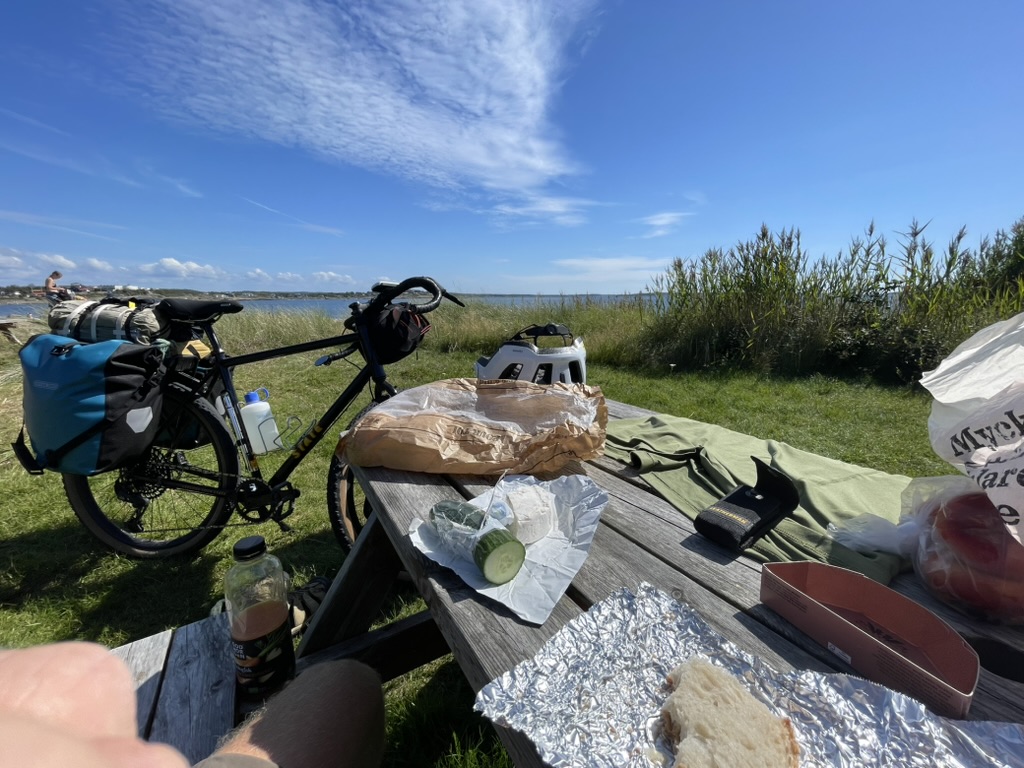
The first day I cycled to a nature reservation called Varberg, some 80 kilometers South of Mölndal. One of the things that struck me the most about Varberg were the beaches. Instead of sand, the coast was made of large slabs of dark rock. This was the second time I had been to a beach along Sweden’s West coast, and once again I was impressed by the rugged terrain and the smooth, mirror-like water lapping gently along the shore.
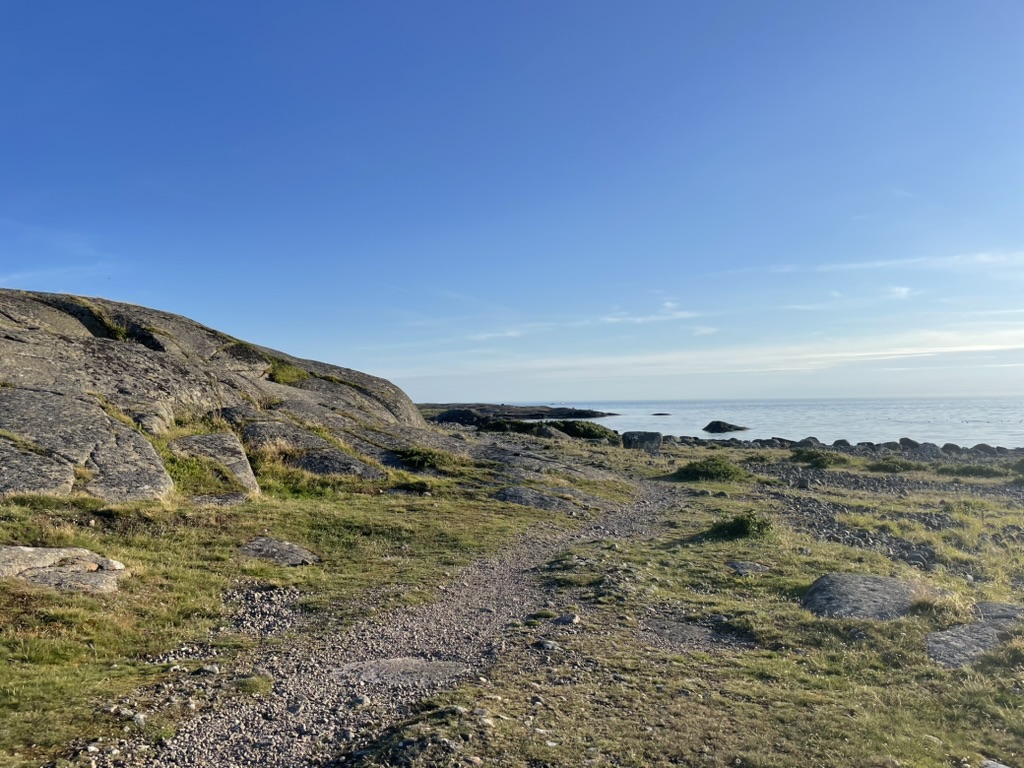
I met a nice cyclist named Leon at the nature reservation that night. He explained to me in fluent English that he was cycling from his home in central Germany (more than 1100 kilometers away) to begin a graduate program up in Gothenburg. Leon was a day away from his destination, but I was months away from mine. We surveyed the reservation together and decided it would be best to camp by the main beach because it was softer and more sheltered from the wind. After swimming in Kattegat for a little while we set up camp. That night we sat under the stars and swapped travel stories over our camp stove cooked meals late into the night, until it was time for bed.
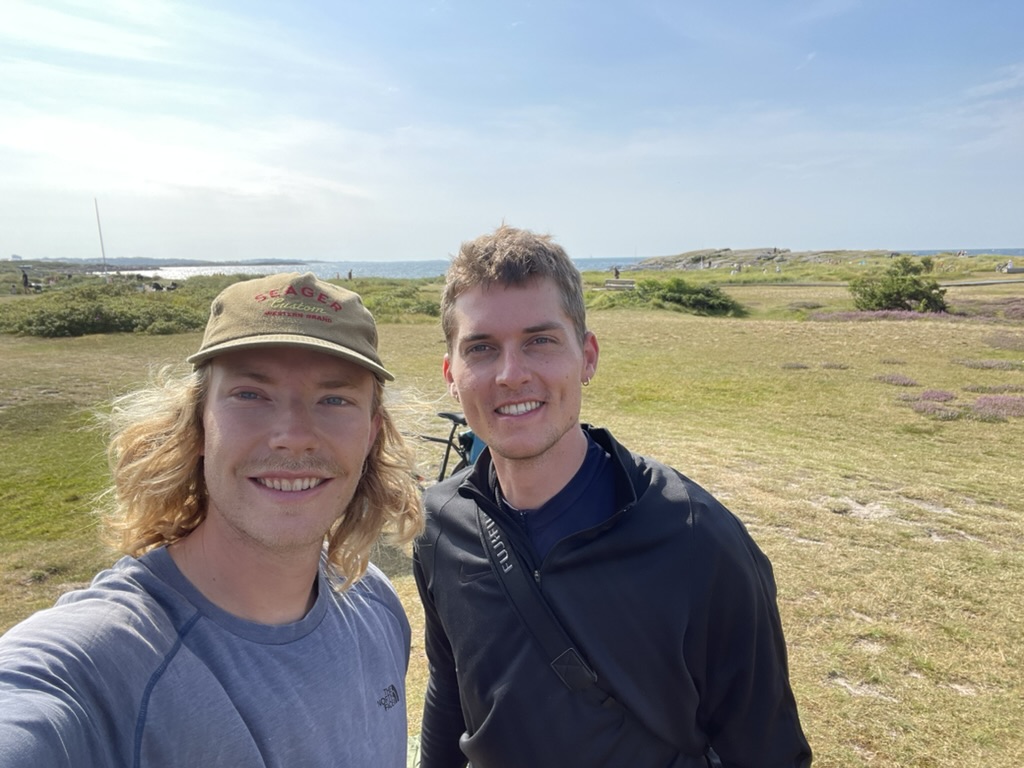
The next morning I said goodbye to Leon. After checking the weather forecast, he made the astute observation that the wind direction was in his favor. I wanted to share in his excitement, but that meant another day of headwinds for me. Though it felt like I was moving at a snail’s pace, I still enjoyed the beautiful coastal views and lack of rain. I managed to cycle another 85 kilometers that day, and ended up at another beautiful nature reservation called Hagöns Naturreservat. One of the unique features of the park was the quantity of shells on it’s beaches. In many parts, the sand was entirely replaced by mounds of shells. I felt bad stepping on them, so I tried my best to hop from rock to rock.
To make things even better, as I was setting up my campsite, I met one of the caretakers, Jörgen. He asked me in makeshift English how far I was riding. I told him to Rome. Unfazed by my lofty travel plans, he began telling me of all the travelers he meets while making his rounds at the campsite. The year prior, he met a guy similarly cycling across Europe who also stayed where I was setting up my camp.
More critically, Jörgen told me where to fill up on water and where I could get breakfast the next day. In an email the following morning, he also gave me some tips for crossing from Sweden to Denmark (from Helsingborg to Helsingør). I didn’t have much food or water left that night, nor had I planned where I was crossing to Denmark, so I was grateful for the tips. It was wonderful meeting friends like Jörgen and Leon during my trip — they gave me the energy and motivation to push through the hours of solitude I experienced each day on my bike.
The following day I made over 90 kilometers through prevailing headwinds while continuing my way down Kattegattleden. Though the wind speed had dropped a little compared to the days prior, it still tested my drive to push onward by bicycle. Fortunately, by midday the sun came out and warmed my back and shoulders.
I passed through picturesque towns with cobblestone roads and 19th century wind mills. Modern stores sold their wears from old buildings built primarily of stone and brick. Once inside, it was as if I had stepped through a time portal from medieval Europe to the present day. Curious Scandinavian faces would occasionally glance my way as I locked my bike before restocking on food or water. Sometimes I’d wonder what they thought of me — a foreigner with long hair and smelly clothes with an overloaded bicycle — was I an intrepid adventurer or a dirty bum? I never asked so I will never know.
By the time the sun started to set I was hungry and tired. After cycling nearly 10 hours through gusty headwinds, I was ready for some chow and a good sleep. After checking out a few prospective spots, I decided on a beach only around 10 kilometers North of Helsingbor, where following Jorgen’s advice I would cross into Denmark the following day. My plan was to be settled in my Coppenhagen hostel by my birthday (August 10th) which was then only two days away. Back at my campsite on the beach, the strong wind I had hoped would subside after the sun set began getting stronger. This made cooking with my tiny camp stove exceedingly difficult, since I didn’t have a windbreak for the flame.
After eating a meager dinner consisting of tofu and onions, I began cleaning and packing my cookware. As I was washing dishes at a water spigot, a middle eastern family waved me over. Though they didn’t speak to me in English, it was obvious they wanted me to join them. I hesitated a moment — after all, these people were strangers and I, like many Americans, were raised to distrust unfamiliar faces, particularly those of foreigners. It was only a moment that I hesitated; I could tell by their smiling, honest expressions that they didn’t want to take advantage of me. I told the family, after they had tried conversing with me in Swedish, that I was from America and, unfortunately, only spoke English. Fortunately, of the family consisting of dad, mom, and big sister, big sister spoke English.
At this point in the story, I’d like to quote a passage I wrote about this encounter in my journal the following morning:
“[INSERT JOURNAL PASSAGE HERE]”
That night the winds were strong, and I never felt 100% comfortable camping at my spot on the beach. After all, there were private homes within a few hundred feet away. These factors made it difficult to get much sleep that night. To make matters worse, shortly after the sun came up it began to rain. I checked my phone and saw that the rain was only supposed to get worse, so I quickly began packing up my things. The wind made this process difficult — to pack up my tent, I had to role it really tight and fold in a special way. Each time I began folding it, my tent effectively became a sail. My tent-sail overcame my rain-slicked grip and flew away from me, resulting in me running after it on the beach.
Once I had finally packed and was ready to go, the light rain had turned to full-fledged rain. Eager to get out of the rain, I dialed my Garmin with the route ahead, aimed my handlebars towards Helsingborg, and set off. Fortunately, I was within ten kilometers from my destination, and reached the city within a half-hour, despite the frustrating head winds and slippery conditions. Speaking of frustrating, once I reached the city I didn’t know where to go to find the ferry. I checked a large, important looking building by the docks, but this proved to be a dead-end. Having skipped breakfast that morning, I was hungry after cycling from my campsite, so I decided to give up on finding my ferry for now in favor of finding my final meal in Sweden.
Thankfully, my departure from the bustling transportation hub posing itself as the ferry terminal provided me the opportunity to explore the old, beautiful city of Helsingborg. Though I only spent a few hours in the city, I was still able to take in the ancient architecture from many of the buildings in the old town. Within many of these old buildings contained modern furnishings. For example, while it was raining particularly hard out, I took shelter in a cafe that appeared to be decades old. After chaining up my bike outside (by this point I already stopped worrying about people stealing from my bike), I walked into the old building and took in the dimly lit, chic modern ambiance. There were many plants inside, and even a fully grown tree in the center, that stretched around 15 feet into the air towards a brood skylight. This was one of the many times I felt the superiority of Scandinavian architecture and furnishings over what was typical in America.
After a warm cappuccino, a nicotine pouch, and writing a journal entry with a fresh pen that I had bought a few minutes before walking into the cafe (which would end up lasting me nearly the full length of my journey), I pushed my way slowly through the rain back towards the direction I had come in hopes of finally finding my ferry. Thankfully, I found some helpful Swedes that knew the area well. I could tell by their expressions as they surveyed my sopping body standing abreast my oversized bicycle plus luggage that they wanted to help me through my sopping predicament. They explained that I needed to follow the car traffic along a windy track and wait with them to board the ferry. My mistake had been borne from thinking I had the same entrance as the foot traffic. Oops.
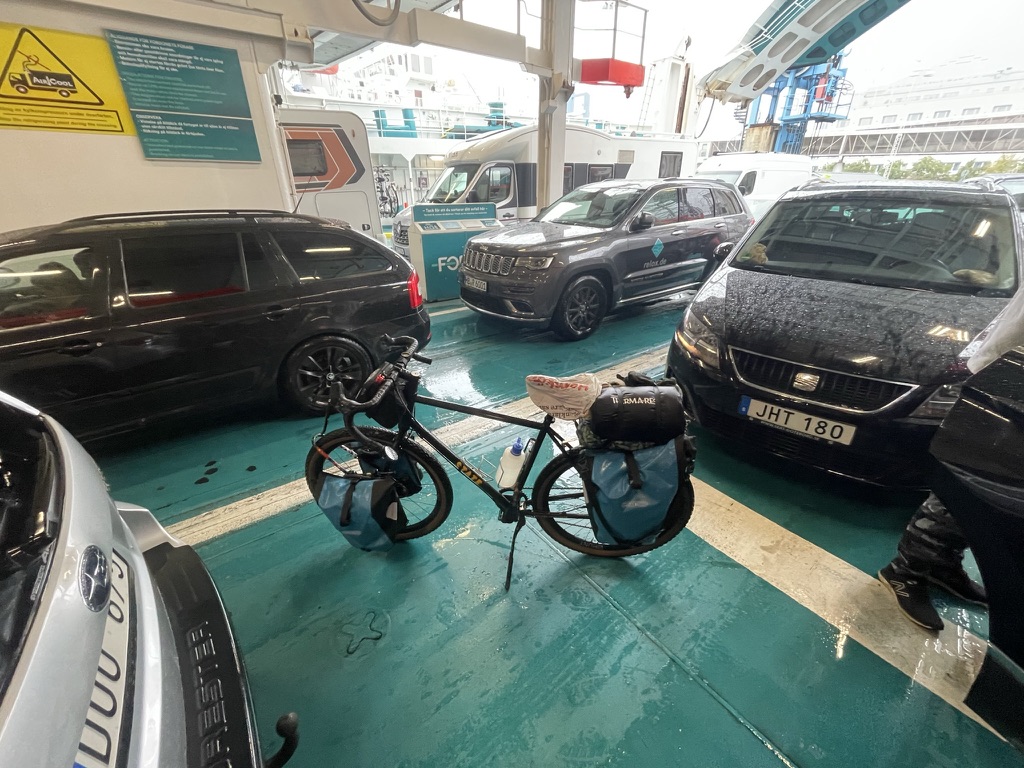
During the ferry ride across Öresund Strait, I wolfed down some food for lunch. The pouring rain was loud against the boat’s 4th level floor-to-ceiling window. I sat next to a family of Scandinavians that were chatting among themselves. The young daughter was watching the rain splattering on the window and giggling. The mother was talking with her husband. They seemed happy. Content. Moments like these caused me to long being back at home with my family and friends. But at the same time, I was happy to be on the road while I was still in my early 20’s. I still had time for a family life if that’s what I want later in life.
The rain was still pouring on the other side in Denmark. I landed in a town called Helsingør. From there, it was still another ~40 kilometers to Copenhagen. My girlfriend at the time, Brooke, had lived in the city when she was a kid, and still remembered much of it. She gave me a list of places to visit that she enjoyed from her childhood. Despite the driving rain, it comforted me to be in a place that was home to someone that I cared deeply about.
By the time I started cycling from the ferry I was already soaked. Thankfully, it was early August and the air temperature didn’t feel very cold, and the headwinds were minimal. It paid off many times during my trip to remain thankful even in moments of extreme discomfort, this leg of the trip was certainly one of those times. The wetness eventually got to me, so I pulled over beneath a bus stop and lit a cigarette. This was something I forgot to mention earlier. In Helsingborg, I had bought a pack of cigarettes. I don’t consider myself a smoker, but something about being immersed in a culture that did not regard it as taboo made me curious to give it a try. It also did a wonderful job with settling my nerves (sometimes). Sitting underneath the bus stop in the pouring rain with 20+ kilometers remaining was one of these times.
 Milo Klein